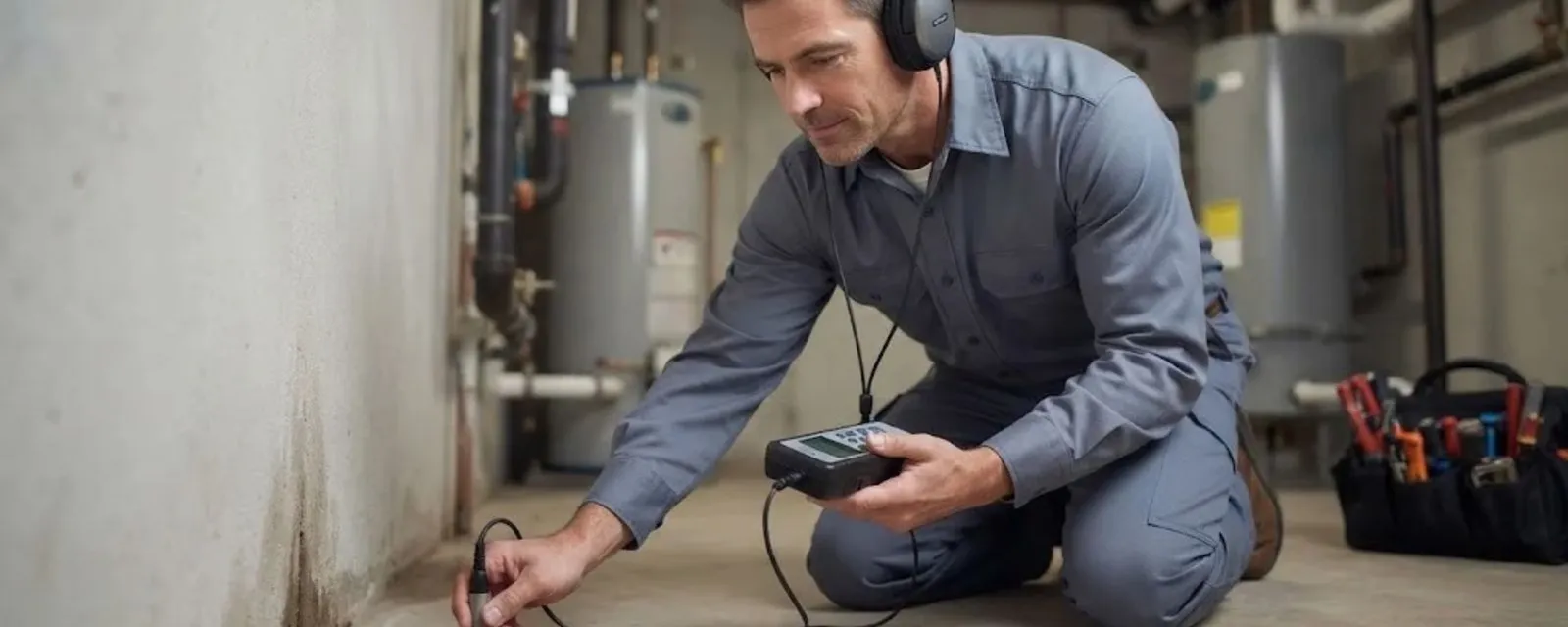
Emergency Leak Detection in Cheltenham, PA
24/7 Emergency Line OpenWater that has nowhere to go will find your drywall, your subfloor and your electrical, so a hidden leak in Cheltenham, PA is an emergency the moment you can see or hear it. Dispatch answers 24/7, including nights and weekends. While you wait, shut the main water valve, keep everyone away from wet outlets and light fixtures, and photograph the damage before you move anything.
Leak detection means locating the exact spot where a pressurized supply line or a drain line is losing water, using meters, listening gear and thermal imaging, before any wall or floor is opened.
When a hidden leak is an emergency
Some leaks can wait for a morning appointment. Others cannot. A ceiling that sags, bubbles or drips, water running near a panel or outlet, a meter dial that keeps turning with every tap closed, and a floor that feels warm in one patch all mean water is escaping under pressure right now.
Pressure matters here. A supply line leaks at street pressure around the clock, so a pinhole that looks minor at noon can soak a wall cavity by midnight. A drain leak only runs when something drains, which makes it easier to live with for a day but just as damaging if ignored.
Shut off the main
Close the main shutoff where the water line enters the house. If the valve will not turn, call us while you keep everyone clear.
Cut power to the wet zone
Switch off the breaker for any room with a wet ceiling or outlet, but only if you can reach the panel without standing in water.
Photograph before you clean
Take wide and close photos of stains, drips and the meter. Insurers and landlords ask for them.
Move what you can
Lift rugs, electronics and boxes off wet floors and place a bucket under drips. Do not poke a sagging ceiling open.
If you are a landlord or property manager calling for a tenant, say so on the call and give us the unit, the stain location and who can let us in. Tenants can describe the symptom while you arrange access.
Meter still moving with everything off
A high water bill with no change in how many people live in the house is the most common reason people call us. Aqua Pennsylvania provides water service in Cheltenham, so the usage line on your Aqua bill is your baseline. If two bills in a row climb while the household stays the same, water is going somewhere you cannot see.
You can run the first test yourself in ten minutes.
- Turn off every tap, the dishwasher, the washing machine and the ice maker.
- Find the meter, which is usually in the basement near the front wall or in a pit near the curb, and look for the small low-flow dial or triangle.
- If the dial spins or the numbers advance while nothing runs, water is leaking somewhere after the meter.
- Close the main shutoff inside the house and look again. If the meter stops, the leak is inside the house. If it keeps moving, the leak is in the buried line between the meter and the house.
The cheapest culprit is a toilet flapper that seeps into the bowl. Drop a few drops of food coloring in the tank and wait 15 minutes. Color in the bowl without flushing means the flapper needs replacement, which our toilet repair team handles.
The International Plumbing Code (IPC) limits static water pressure at fixtures to 80 psi and calls for a pressure-reducing valve above that. Pressure above 80 psi is a common hidden cause of pinhole leaks and running meters, so a gauge reading belongs in every leak check.
Water is going somewhere. Call the 24/7 line.
Tell dispatch what you see and hear, and we will tell you what to shut off first.
Water stains on ceilings and walls
A brown ring on a ceiling tells you where water arrived, not where it started. Water travels along joists, pipes and the top of drywall before it finds a low spot, so the stain can sit several feet from the source.
The usual suspects are a supply line or drain above the ceiling, a shower pan or tub overflow, an air conditioner condensate line, and the roof. A quick sorting question helps: does the stain grow on dry days? If yes, plumbing is the likelier cause. If it only grows during rain, a roofer should look first, and we will tell you plainly when a leak is outside our trade.
We trace wall and ceiling leaks with a moisture meter and a thermal imaging camera, then pressure-test the suspect line. That lets us open one small access hole in the right place instead of a long trench of drywall.
Basement and crawlspace leaks in older homes
Cheltenham is an older township, and much of the housing stock has stayed largely unchanged since the early twentieth century. In houses like that, the pipes that matter most are often the ones you see least: cast iron drain stacks, old copper and galvanized supply runs, and buried lines under a basement slab.
Tookany Creek runs through the township, and the U.S. Army Corps of Engineers noted in 2015 that urban runoff has reduced the creek's carrying capacity. For you, that means a wet basement is not always a plumbing leak. Damp walls after heavy rain point to groundwater, while a steady puddle on a dry week points to a pressurized line or a failing drain.
We separate the two with a simple shutoff test and a look at the pattern of the moisture. If the answer is groundwater, basement waterproofing is the right repair, and if the cause is a failed pump we move to sump pump repair.
Warm floors, hissing and slab leaks
A slab leak is a break in a pipe that runs in or under a concrete floor. It shows up as a warm patch on the floor (a hot line leaking), the faint sound of running water at night, damp carpet along a wall edge, or a bill that keeps rising.
Slab construction is less common than basements in older Cheltenham houses, but additions, garages and mudrooms are often built on slabs, and a line can run beneath them. We isolate sections of piping with pressure gauges, then use an acoustic listening device and a pipe locator to mark the spot on the floor.
Repairs fall into three paths: break the slab and fix the pipe, abandon the failing run and reroute it through walls or the attic, or replace the whole line. When several pinholes show up in the same material, a full repiping job often costs less than chasing leaks one at a time.
Service line and underground leaks
The service line carries water from the main in the street to your meter and house. A leak on that run drains into the soil, so the signs are outside: a soggy strip of lawn that never dries, a green patch in winter, low pressure at every fixture, or the sound of rushing water near the meter.
Who repairs which part depends on where the utility's responsibility ends and yours begins, and that boundary is worth confirming with Aqua before any digging. We locate the leak first, mark it, and tell you exactly how far the line must be opened.
| Leak type | Telltale sign | How we locate it | Usual repair path |
|---|---|---|---|
| Toilet or fixture seep | Meter moves slowly, bill up a little | Dye test, shutoff isolation | Replace flapper, valve or supply |
| Wall or ceiling supply leak | Spreading stain, damp drywall | Moisture meter, thermal camera, pressure test | Small access hole, section replacement |
| Slab leak | Warm floor, sound of running water | Pressure isolation, acoustic locator | Spot repair, reroute or repipe |
| Service line leak | Wet lawn, low pressure, meter runs | Ground microphone, line tracing | Spot dig or line replacement |
| Drain line leak | Smell, stain after use, soft floor | Camera and fill test | Section replacement or lining |
Smaller cases we also check
Irrigation systems. A stuck zone valve or a cracked sprinkler head can add thousands of gallons a season to a bill without a single indoor symptom. We shut off the irrigation branch and watch the meter to confirm.
Pools and spas. If your property has a pool or spa, a drop in water level that outpaces evaporation can be a plumbing line rather than the shell. We test the supply and return lines separately and tell you what falls outside our work.
Yard and meter-box leaks. Water bubbling around the meter box or a hose bib can be a failed fitting rather than a buried break, and those are quick, inexpensive fixes once found.
How we find a leak before anything is cut
The goal is a confirmed location and a plain explanation of the repair before a wall is opened. Our process runs in order, and each step narrows the search.
- Interview and meter check: what you saw, when it started, and whether the meter moves with the main closed.
- Isolation: shut off sections of the house and watch pressure gauges to learn which line is losing water.
- Listening and imaging: acoustic sensors, moisture readings and a thermal camera mark the likely spot.
- Camera work for drains: a sewer or drain camera, described on our sewer camera inspection page, checks whether the loss is on the waste side.
- Confirm and explain: we show you the readings, name the repair, and give a clear price before work starts.
What shapes the cost of a leak search and repair
- AccessA leak behind a tub wall costs more to reach than a leak in an open basement ceiling.
- Pipe materialCopper, galvanized steel, PEX and cast iron repair differently and carry different parts costs.
- Depth and surfaceA service line under a lawn is simpler to open than one under a driveway or a finished floor.
- Number of leaksOne pinhole is a spot repair. Several in the same run often points toward replacing the run.
- Restoration needsWe handle the plumbing. Drywall, paint and flooring after the repair are separate trades.
Insurance is worth a call early. Many homeowner policies cover sudden water damage from a burst or accidentally discharged pipe, while gradual leaks and ordinary wear are often excluded, so read your own policy and ask your carrier what it requires. Want your real number? Call (215) 714-6692 and a clear price is given before work starts.
Cheltenham local note: what the township and Aqua mean for your leak
Two facts shape leak work here. First, Aqua Pennsylvania provides water service in Cheltenham and bought the township's sanitary sewer system in a $50.25 million deal announced in July 2018, so one company now sits behind both your water and sewer bills. If your bill jumps, you can ask Aqua about your usage while we find the cause inside.
Second, Cheltenham Township Code Chapter 238 prohibits letting extraneous water such as downspouts, sump discharge and hoses enter a sanitary sewer lateral, and the township can require a fix within 60 days of notice.
A leaking drain or a disconnected pipe can look like that problem, which is why we document what we find. Neighbors in Elkins Park and nearby calls often start the same way: a stain, a meter that will not rest, and a question about who pays.
Frequently asked questions
Yes. Dispatch is open 24/7, and an active leak with a sagging ceiling, water near electrical, or a runaway meter is exactly what the night line is for. Shut off the main first, then call (215) 714-6692 and describe what you see.
Close every fixture and read your meter, then read it again after 15 minutes. If the dial or digits moved, water is leaking. Compare the usage line on your Aqua bill across several months, because a steady climb with no household change is the usual pattern.
Not as a first step. We use pressure isolation, moisture readings and thermal imaging to narrow the spot, then open the smallest access hole that gets to the pipe.
Policies differ. Some cover the cost of finding a covered sudden leak, while gradual leaks and maintenance issues are commonly excluded. Photograph the damage, keep your reports, and ask your carrier before repairs begin.
Yes. Give us the unit, the symptom and an access contact, and we coordinate the visit. Tenants can describe what they see while the owner approves the work.
Then plumbing is not the cause and we will say so. A stain that grows only during rain points to the roof, flashing or windows, and a roofer is the right call.
We check irrigation supply lines and the plumbing that feeds a pool or spa. The pool shell and equipment pad fall outside our work.
Found a stain or a spinning meter?
Call (215) 714-6692 and a live dispatcher answers around the clock.