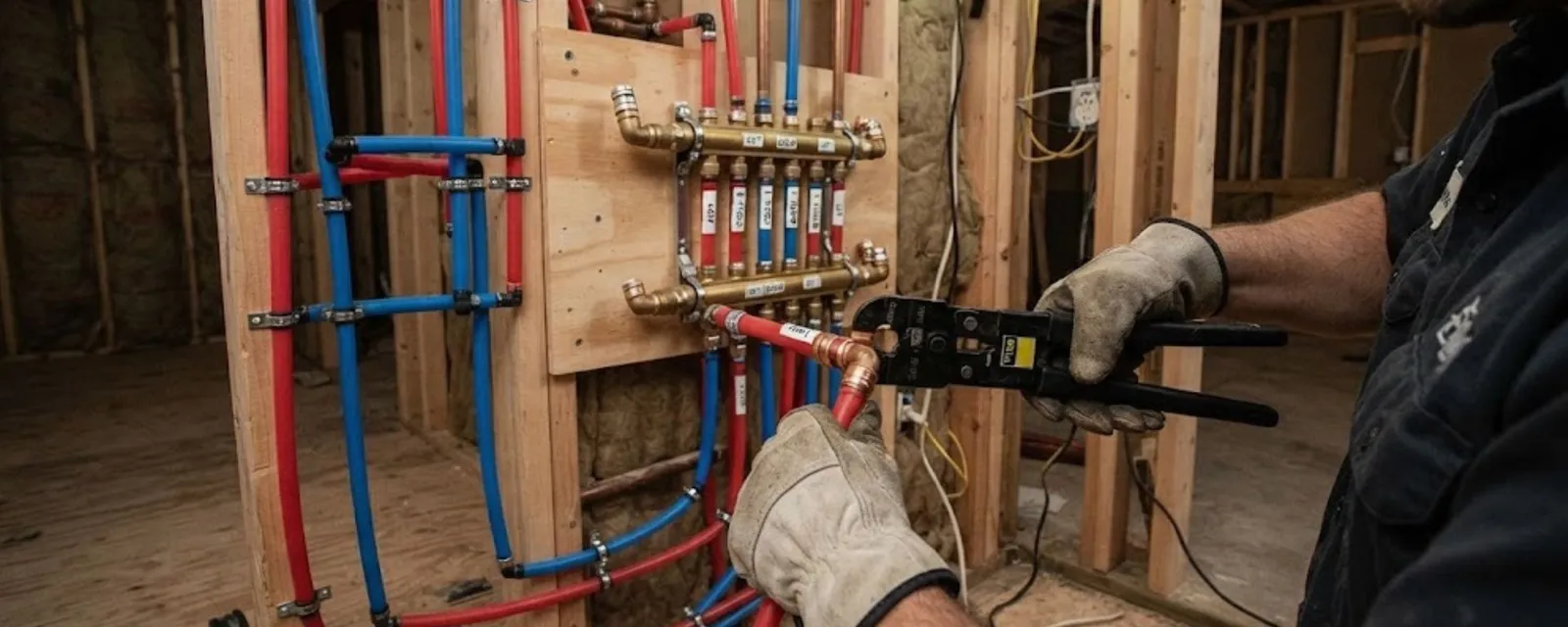
Repiping in Cheltenham, PA
24/7 Emergency Line OpenRepiping in Cheltenham, PA means replacing the water supply lines inside your house when old pipes leak, rust or lose pressure faster than repairs can keep up. Cheltenham's older houses are the usual candidates, and same-day appointments are available when the schedule allows.
A repipe is a planned project, so you get a clear price before work starts and a plan for keeping water on as much as possible.
Signs your pipes are near the end of their life
No single symptom proves a pipe has to go. A pattern does. Look for these together.
- Brown, orange or cloudy water that clears after a minute of running.
- Weak flow at several fixtures, not just one aerator.
- A second or third pinhole leak on the same run within a couple of years.
- Visible green crust on copper joints or flaking rust on galvanized steel.
- Water that tastes metallic or leaves rust marks around fixtures.
If you are already looking at a wet ceiling, our leak detection team can find the leak first, and repiping decisions can wait until you know whether it is one break or a whole run giving up.
Galvanized, copper and old solder in early twentieth century houses
Cheltenham has a long building history. The township was founded in 1682, grew with the estate era of the late 1800s and early 1900s, and much of its housing has stayed largely unchanged since. Houses from that period may still carry original galvanized steel, copper added in later renovations, or mixed systems patched together over decades.
Galvanized steel corrodes from the inside, so the pipe can look fine outside while its opening shrinks to a fraction of its original size. Copper lasts much longer, but solder from earlier eras can fail at joints. Neither is a reason to panic. Both are reasons to know what you actually have before a leak decides for you.
The International Plumbing Code (IPC) lists copper, PEX and CPVC among the approved water supply materials, and each behaves differently in an old house. Ask which one is proposed for your walls and why, and ask that all joints be pressure tested before drywall goes back.
Safety steps before the crew arrives
- Clear the paths to the main shutoff, the water heater and every room with a fixture.
- Move furniture and valuables away from walls where the crew will open drywall.
- Plan for a day or more without running water and arrange alternatives.
- Ask whether any old pipe or insulation could contain asbestos before it is disturbed.
- Confirm who closes up the walls and who pulls any permit.
Ready to talk repiping? Call us.
Describe the house and the symptoms, and we will tell you what to expect.
Low water pressure: pipes, valve or something else
Low pressure is a symptom with several causes, and only some of them are repipe problems. We work through them in order.
| What you notice | Likely cause | Repipe needed? |
|---|---|---|
| One faucet weak | Clogged aerator or cartridge | No |
| Hot side weak only | Water heater valve or sediment | No |
| Whole house weak, worse over time | Narrowed galvanized supply | Often yes |
| Sudden drop at every fixture | Partly closed main valve or failed pressure reducer | No |
| Weak with a wet lawn outside | Leaking service line | Line repair, not interior |
A simple gauge screwed onto a hose bib tells us static pressure. A reading that is healthy with the water off but collapses when you open a tap points toward restricted pipe.
Lead service lines and what Aqua publishes
Some older properties still have a lead or lead-jointed service line, the pipe that runs from the main in the street to your meter. Aqua Pennsylvania publishes a service line inventory at aquawater.com/leadmap, and you can search your address there. We do not make health claims about lead exposure. If the inventory shows a lead line or an unknown material, ask Aqua about its replacement program.
Inside the house, a repipe replaces the supply lines that Aqua does not own. When a lead service line is part of the picture, we plan the interior work so it can connect to a new line later.
PEX, copper or CPVC: how we choose
There is no single best pipe. The right material depends on the house, the water and your budget.
| Material | Strengths | Trade-offs |
|---|---|---|
| Copper | Long track record, fire resistant, no plastic | Higher material cost, slower to install |
| PEX | Flexible, fewer joints, quicker, tolerates freezing better | Needs protection from sunlight and some chemicals |
| CPVC | Low cost, easy to cut | Can turn brittle with age and heat |
In houses with plaster walls, PEX is often the least destructive because it can be fished through cavities with fewer access holes. In exposed basements, copper is often neat and durable. We explain the choice and let you decide.
How a repipe goes in an occupied house
- Walkthrough and plan: we trace the existing runs, mark every fixture and choose routes that minimize wall openings.
- Staging: we protect floors and furniture and set up a temporary water plan so you are not without water for long.
- Rough-in: new lines are run through basements, attics and wall cavities, then connected to the main and fixtures.
- Pressure test: the system is tested under pressure before any wall is closed.
- Reconnect and clean up: fixtures are reconnected, water is turned on, and we walk the job with you.
Drywall and plaster patching are separate trades. Most homeowners schedule a drywall finisher right behind us.
Whole house or just one run?
A partial repipe replaces one failing branch, such as the kitchen or a bathroom stack. It costs less and often solves the immediate problem, but it leaves old pipe elsewhere. A whole-house repipe replaces everything at once, which makes sense when pinholes appear in more than one place or when you are already opening walls for a remodel.
If your goal is a bathroom remodel, see our plumbing installation page for rough-in work, and if a pipe has already burst, burst pipe repair gets the water stopped first.
What drives the price of a repipe
- House size and layoutMore fixtures and more floors mean more pipe and more connections.
- Wall and floor accessPlaster, tile and finished basements take longer to open and protect.
- Material choiceCopper, PEX and CPVC differ in material and labor cost.
- ScopeOne run versus the whole house changes both cost and schedule.
- Fixtures and valvesNew shutoff valves, a pressure reducer or an expansion tank add to the scope.
Insurance rarely pays for replacing pipes simply because they are old, though it may cover damage from a sudden failure. Check your own policy. Want your real number? Call (215) 714-6692 and a clear price is given before work starts.
Cheltenham local note: licensing and permits
Under Cheltenham Township Code Chapter 209, plumbing and drainage work must be done by plumbers licensed and registered through the township, and registration renews each December. A call to the township at 215-887-1000 will confirm whether a plumber is registered.
Permit rules vary, so ask the Cheltenham Township building department before work begins. Houses in the Abington Township portions of Glenside and Elkins Park fall under Abington's contractor registration rules instead. If you live near Wyncote's historic district, mention it when you call so inspections are scheduled with the right office.
Frequently asked questions
It depends on the size of the house and the access. Many repipes are done over a few days, and we plan the schedule with you so water is off for as little time as possible.
Usually not. Water is off for stretches of the day, and we set up a temporary plan. Dust and noise are the main inconveniences.
Not always. One pinhole is usually a spot repair. A pattern of leaks in the same pipe type or age suggests the whole run is failing.
There is no single answer. Copper, PEX and CPVC all work, and we recommend the one that fits your walls, budget and water. Ask us for a side by side.
Sometimes. If the cause is corroded galvanized steel, yes. If it is a failed pressure reducer or a partly closed valve, no, so we test before recommending a repipe.
Aqua Pennsylvania publishes a service line inventory at aquawater.com/leadmap. Search your address and ask Aqua about replacement options if a lead line is listed.
Yes. Send us the unit details and an access contact, and we coordinate with tenants and schedule around occupancy.
Planning a repipe in Cheltenham?
Call (215) 714-6692 and talk through the options with a live dispatcher.