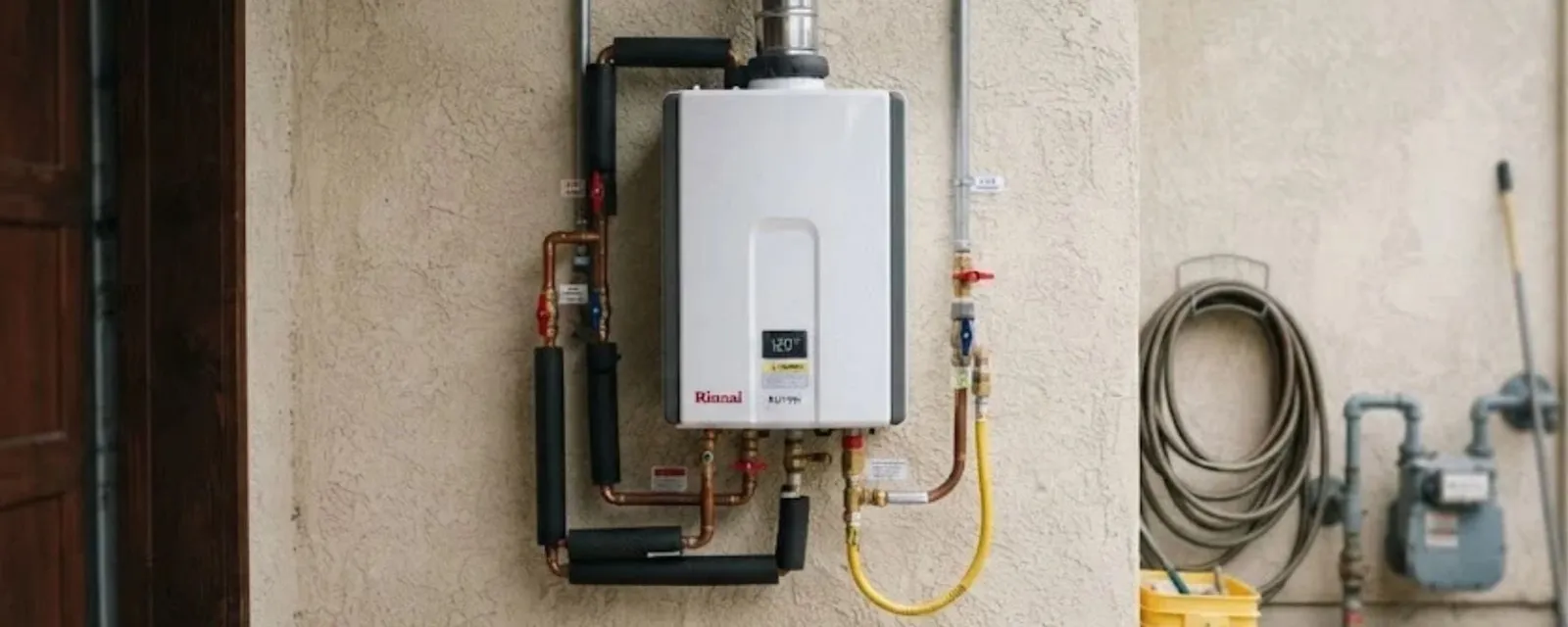
Tankless Water Heater Service in Cheltenham, PA
24/7 Emergency Line OpenA tankless water heater heats water only when you open a tap, so it never runs out and takes far less floor space than a tank. Our tankless water heater service in Cheltenham, PA covers installation, repair and the annual descale flush that keeps these units running.
The catch is that tankless units are less forgiving. They need the right gas line, a correct vent and clean water passages, and we plan around all three.
Flushing and descaling: the maintenance that matters most
Inside a tankless unit, a compact heat exchanger carries water past a hot burner. Minerals in the water slowly form scale on those surfaces, narrowing passages and reducing flow. Error codes, lukewarm water and a noisy unit are the usual signs.
A descale flush circulates a mild acid solution through the heat exchanger using a small pump and two hoses, then rinses and returns the unit to service. We also clean the inlet screen and check the combustion fan on gas models.
| Sign | Likely cause | Typical response |
|---|---|---|
| Water turns lukewarm at low flow | Scale or a dirty inlet screen | Clean the screen and flush the exchanger |
| Error code on the display | Ignition, flame sensor or flow issue | Read the code and test the part |
| Rumbling or kettle noise | Scale boiling in the exchanger | Descale flush |
| Cold water sandwich | Flow too low or recirculation issue | Check settings and flow |
| Unit shuts off mid shower | Safety limit or venting problem | Inspect vent and temperature limits |
Hard or mineral-rich water makes flushing more important, and we do not state a hardness figure for your address. Test your tap, or ask Aqua Pennsylvania for the water quality report covering your home. Annual flushing is the common recommendation, and your manufacturer's manual gives the exact interval.
Before you switch: what tankless requires
Most gas tankless units draw a high volume of gas, often more than a tank heater, so the existing gas line may need to be larger. The vent must use the pipe material the manufacturer specifies, usually stainless steel or approved plastic for condensing models, and it must terminate in an approved location.
A condensing unit also needs a drain for acidic condensate. Electric tankless models draw heavy amperage, which can exceed what an older panel supports. We review each of these conditions before quoting.
- Gas line size and meter capacity checked against the unit's input rating
- Vent route, material and termination confirmed
- Condensate drain and neutralizer provided where required
- Water flow and temperature rise matched to household demand
- Isolation valves installed so the unit can be flushed later
If your tank has only failed and you are comparing options, the water heater replacement page sets tank and tankless side by side.
Gas tankless units are installed to the manufacturer's instructions and to NFPA 54, the National Fuel Gas Code standard, which governs gas piping and venting. Venting and gas line size are the usual surprises, so ask for both to be confirmed before you buy the unit.
Time for a tankless flush?
Call to schedule a descale flush or talk through an upgrade.
Tankless repairs: what usually goes wrong
- Flame sensor and igniter faults keep the burner from lighting or cause it to shut off after a few seconds.
- Flow sensors and thermistors report the wrong temperature or flow and trigger safety shutdowns.
- Clogged inlet filters limit flow and cause lukewarm output.
- Condensate drain blockages trip the unit on condensing models.
- Vent problems cause pressure switch faults, which we correct rather than bypass.
Many tankless faults appear as manufacturer error codes. We read the code, test the part it points to, and explain what failed. If a unit is under warranty, we tell you which repairs belong to the manufacturer.
Cheltenham homes and tankless upgrades
Older Cheltenham homes in Wyncote, Elkins Park and Glenside often have basement chimneys, original gas piping and compact utility rooms. A tankless unit mounts on a wall and frees floor space, which can help in these tight rooms.
The older gas line is the more common limit. A line sized for a furnace and a tank may not carry a tankless load, and that is a conversation we have on the first visit rather than after the unit arrives.
What affects tankless pricing
- The unitModel, capacity and condensing or non-condensing design set the equipment cost.
- Gas supplyUpsizing a gas line adds pipe, fittings and time.
- VentingA new stainless or approved plastic vent run is a major scope item.
- Water treatmentA scale filter or isolation valves add parts but cut long-term service.
- Service planAnnual flushing and inspection add a recurring cost that buys longer life.
You hear a clear price before work starts. Tankless installation is an upgrade rather than an insured loss, though a sudden failure of an existing tank may qualify for water damage coverage. Call (215) 714-6692 and we will help you plan.
Frequently asked questions
Many manufacturers recommend yearly service, more often in areas with mineral-heavy water. Check your manual and your water quality report, or call us to set a schedule.
It can be, if the gas line, venting and panel can support it. The savings in floor space and the endless hot water are real, but the scope can be larger than a tank swap. We assess before you commit.
Codes point to ignition, flow, venting or sensor faults. We read the code, test the part and explain the fix.
Scale builds quietly. Flushing before symptoms appear protects the heat exchanger and the warranty on many units.
Yes. We repair and flush most major brands. Share the model number from the data plate when you call.
It can, and our dispatch line answers around the clock. If the unit leaks or smells of gas, shut off the supply, and for gas smells leave the building and call PECO at 1-800-841-4141 or 911 first.
Ready for endless hot water?
Call (215) 714-6692 to plan your tankless installation or service.