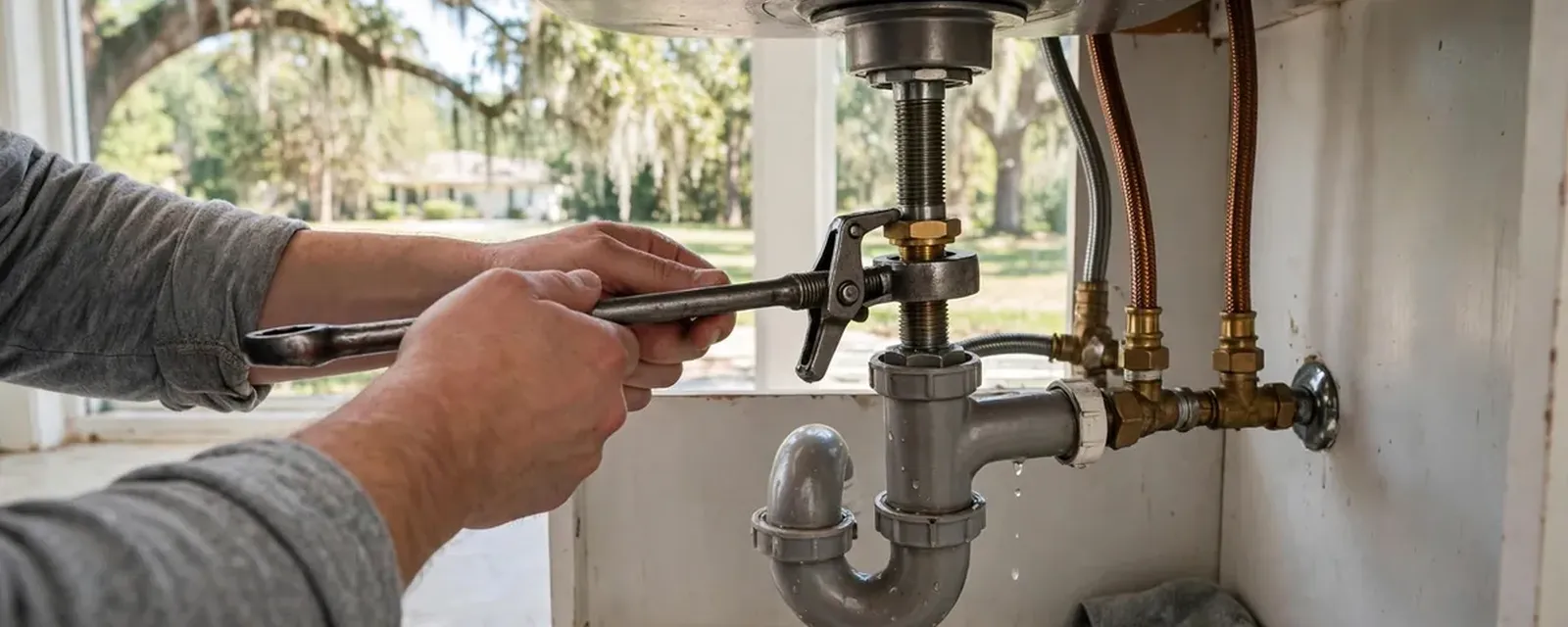
Kitchen Sink Plumbing Replacement: A Cheltenham, PA Homeowner Guide
Replacing kitchen sink plumbing in Cheltenham, PA covers everything below the faucet: the two stop valves, the braided supply lines, the P-trap, the tailpiece and the drain run into the wall. A faucet swap is a fair afternoon job for a handy homeowner. Corroded stop valves, a weeping drain connection or an old galvanized drain stub are where most DIY jobs go wrong.
The short answer is to replace the parts that leak, seize or corrode, and to replace the whole set at once if two or more are failing. Doing the whole set costs a little more in parts and saves a second trip when the next old part gives out.
What counts as kitchen sink plumbing
Under a typical kitchen sink you will find a hot and a cold stop valve (also called an angle stop), a pair of flexible supply lines running up to the faucet, and a P-trap that holds a water seal against sewer gas. The trap connects to a tailpiece from the strainer basket and to a trap arm that runs into the wall or floor.
Many kitchens add a garbage disposal, a dishwasher drain hose with a high loop, and a small filtered water line. Each of these ties into the same cabinet space, so a failure in one often looks like a leak in another. Water running down a pipe and dripping off the lowest fitting is the usual reason people replace the wrong part first.
If your disposal is the problem, the repair path is different, and our garbage disposal repair page explains what a plumber checks before recommending a replacement.
Signs the plumbing under your sink is due
- A stop valve that drips from the stem when you turn it, or will not turn at all.
- Green or white crust on brass fittings, which means a slow weep that has been running for months.
- A supply line with a bulge, a rust-colored braid, or rubber that feels soft.
- A cabinet floor that is swollen, stained or smells musty, even when the sink looks dry.
- A P-trap made of thin chrome-plated metal that has pinholes or a thread worn smooth.
- A sink that gurgles or drains slowly after you have cleared the strainer, which points to the drain run and not the trap.
Put a dry paper towel under each fitting and run the water for two minutes. A wet spot tells you exactly which joint to replace. Do this before you buy parts, because the leak is often one washer and not the whole assembly.
Need a plumber now? Dispatch is open 24/7.
Call the line and describe what is happening. A live person answers around the clock.
Replace one part or the whole run: a decision table
| What you see | Likely cause | Usual fix | DIY or plumber |
|---|---|---|---|
| Drip at the trap nut | Worn washer or cross-threaded slip nut | New trap washers, or a new trap kit | DIY for most homeowners |
| Drip at the faucet base | Failed cartridge or O-ring | Faucet repair or new faucet | DIY if the stops shut off fully |
| Stop valve weeps at the stem | Packing nut loose or worn | Replace the stop valve | Plumber if the main must be shut off |
| Stop valve will not close | Mineral buildup inside the valve | Replace with a quarter-turn valve | Plumber, since the house supply must be closed |
| Slow drain past the trap | Grease and debris in the drain run | Cable the line, then inspect | Plumber if it returns within weeks |
| Rusted or leaking wall stub | Old galvanized or cast pipe | Cut out and rebuild the stub | Plumber, because it opens the wall |
If two rows in this table describe your sink, replace the whole set in one visit. The labor to open the cabinet and shut off the water is the same either way, so the second part is nearly free to do while everything is apart.
How a full kitchen sink plumbing replacement goes
- Close the stop valves. If they will not close, shut the main water valve and open a low faucet to drain the lines.
- Place a bucket under the trap, loosen the slip nuts and remove the trap, tailpiece and strainer connection.
- Disconnect the supply lines from the stops and the faucet shanks, then replace the stops with quarter-turn valves if the old ones are multi-turn.
- Fit new supply lines hand-tight plus a quarter turn with a wrench, and avoid overtightening the compression nuts.
- Assemble a new trap with fresh washers, set the tailpiece to the correct height, and slope the trap arm slightly toward the wall.
- Turn the water back on slowly, check every joint with a dry paper towel, then run the sink full and release it to test the drain under load.
Plumbers test the drain under load because a trap that holds water while the sink is empty can still weep when two gallons rush through it. Skipping that test is why a job that looked perfect at noon leaves a puddle by dinner.
What drives the cost of the job
- Parts qualityBrass stops and braided stainless supply lines cost more than plastic, and they outlast the cheap kits.
- AccessA cramped cabinet with a disposal, filter and dishwasher hose takes longer to clear than an open one.
- Condition of the wall stubA sound copper stub is a quick connection. A corroded galvanized stub means opening the wall and rebuilding it.
- Number of parts replacedReplacing stops, lines and trap together shares one setup, so the per-part cost drops.
- Faucet supplied or notLabor to install a faucet you bought differs from labor plus a faucet we source.
We do not post a flat number because no two cabinets match. A clear price is given before work starts, and you can call (215) 714-6692 to describe what is under your sink and get your real number.
On insurance: sudden pipe failures that cause water damage are often covered, while slow leaks and worn parts are usually treated as maintenance. Read your own policy, and photograph any damaged cabinet floor before cleanup.
What to do yourself and what to hand off
Swapping a trap kit, replacing supply lines on working stops, and installing a new faucet are reasonable weekend tasks. You need adjustable pliers, a basin wrench for the faucet nuts, and plumber's tape only on threaded connections that call for it.
Hand the job off when a stop valve will not close, when the wall stub moves as you work on it, when you find lead-colored solder joints or brittle old pipe, or when the cabinet floor is already soft. These are the moments a small repair becomes a flooded kitchen. Our team also handles the larger plumbing installation work when a kitchen remodel moves the sink.
Cheltenham local note: licensing, permits and your water bill
Cheltenham Township Code Chapter 209 (Plumbing Standards) requires plumbing and drainage work to be done by a licensed plumber, with licenses re-registered each December. You can call the township at 215-887-1000 and ask whether a plumber is registered before you hire.
Permit rules for replacing sink plumbing vary, so ask the Cheltenham Township building department at 215-887-1000. If your home sits on the Abington Township side of Elkins Park or Glenside, call Abington Township at 267-536-1000 instead, since the permit office depends on which side of the line the property is on.
Much of the housing stock in the township has stayed largely unchanged since the early twentieth century. In older kitchens that often means the supply stubs and drain lines behind the cabinet are original, so plan for the possibility that opening the wall reveals more than the visible fittings suggested. Homeowners in Elkins Park and Wyncote should budget time for that.
Frequently asked questions
Yes for a faucet, trap and supply lines on working stop valves. Call a plumber if a stop will not close, the wall stub is corroded, or the cabinet floor is already soft.
A straightforward set of stops, supply lines, trap and faucet is usually a half-day visit. Opening a wall to rebuild a corroded stub adds time and is explained before work starts.
If the old stops are multi-turn, stiff or crusted, yes. A new quarter-turn stop costs little next to the faucet and gives you a reliable shutoff for the next repair.
A slow weep at a fitting can dampen the cabinet floor for weeks. Run a dry paper towel along each joint and the dishwasher hose to find it, and call us at (215) 714-6692 if you cannot.
Tenants and property managers call us often. Tell the landlord in writing, photograph the damage, and we can schedule the repair with the owner's approval.
Permit rules vary, so ask the Cheltenham Township building department at 215-887-1000. Properties on the Abington side of the line should call Abington Township at 267-536-1000.
Dispatch is open 24/7. If water is running, close the stop valves or the main shutoff first, then call (215) 714-6692 and we will line up the repair.
Plumbing emergency in Cheltenham?
Call (215) 714-6692 now. A live dispatcher answers 24 hours a day.